🚗🧂 The “Glass of Salt in Your Car” Trick — A Safer, Useful Version
🌟 Introduction
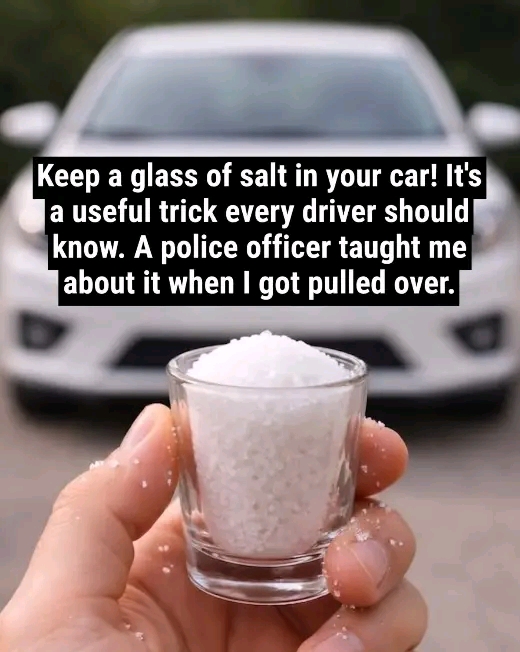
The image claims that keeping a glass of salt in your car is a useful trick every driver should know. There is some truth behind the idea of using salt around a car in winter, but it is important not to treat the viral tip as a miracle solution.
Salt is useful because dissolved sodium chloride lowers the freezing point of water, which is why salt is commonly used for icy roads.
However, simply leaving a full open glass of dry salt inside a moving car isn’t especially useful and can easily spill. Salt can also contribute to corrosion when it gets onto metal surfaces.
So here is a practical version of the idea that you can actually use.
🧂 Winter Car Salt & Windshield Helper
⏱ Preparation
5–10 minutes
🚗 Best for
Cold or frosty mornings, especially when your windshield develops ice.
⭐ Difficulty
Very easy
🛒 Ingredients
For a simple salt-water de-icing solution:
- 1 liter of lukewarm water
- 2–3 tablespoons of ordinary table salt
- 1 clean spray bottle
- 1 plastic windshield scraper
- 1 microfiber cloth
Optional emergency kit:
- A pair of gloves
- A small towel
- A windshield cover
- A sealed container or zip bag for keeping the salt dry
Important: Don’t simply sprinkle dry salt over your windshield. A salt solution is more practical, and using salt directly on the glass can create scratching or residue problems if particles are rubbed across the surface.
👩🍳 Method 1 — Make the Salt-Water Solution
Step 1
Pour 1 liter of lukewarm water into a clean bottle or container.
Step 2
Add 2–3 tablespoons of salt.
Step 3
Close the container and shake until the salt has dissolved.
Step 4
Pour the solution into a spray bottle.
Step 5
Keep the bottle somewhere secure. Do not leave an open glass of salt where it can tip over while driving.
🚘 Method 2 — How to Use It on Frost
When you find a light layer of frost on the windshield:
- Park safely.
- Start the vehicle according to its normal operating instructions.
- Turn on the windshield defrost setting.
- Spray a small amount of the salt-water solution over the frosted area.
- Wait briefly for the frost to loosen.
- Use a plastic scraper to remove the softened ice.
- Wipe the glass with a clean microfiber cloth.
- Make sure the windshield, mirrors and other windows are completely clear before driving.
AAA recommends using the vehicle’s defrost system and a plastic scraper for ice removal. It also warns against using hot water because sudden temperature changes can crack glass.
🧊 Method 3 — An Even Better Winter Trick
If your main problem is overnight frost, a windshield cover is often simpler than trying to remove ice in the morning.
Before going to bed:
- Make sure the windshield is clean and dry.
- Place the windshield cover over the glass.
- Secure it properly.
- In the morning, remove the cover.
- Brush away any remaining frost or snow.
- Check that the windshield and mirrors are completely clear.
AAA notes that windshield covers can help prevent ice buildup and make morning removal easier.
🧪 The Science Behind the Trick
Why does salt work?
Pure water normally freezes at about 0°C (32°F). When salt dissolves in water, it interferes with the formation of the organized ice structure, lowering the temperature at which the solution freezes. This is called freezing-point depression.
That’s why salt has traditionally been spread on icy roads.
But there is an important limitation: ordinary sodium chloride becomes much less effective as temperatures fall. One winter-salt guide lists about 15°F (−9°C) as its practical lower range for melting ice, although actual performance depends on conditions.
So more salt does not automatically mean better results.
📜 A Little History
Salt has been used for centuries as a food preservative and seasoning, but its large-scale use for winter transportation became especially important during the 20th century.
Modern road authorities use sodium chloride and other de-icing chemicals because they can lower the freezing point of water and help prevent snow and ice from bonding strongly to pavement.
Today, alternatives such as calcium chloride, magnesium chloride, sand and other materials may also be used depending on temperature and road conditions.
❤️ Formation of the Perfect Winter Car Kit
Instead of thinking:
“I need a glass of salt in my car.”
Think:
🧂 + 💦 + 🧤 + 🧽 + 🪟
Salt → useful for preparing a de-icing solution
Water → dissolves the salt
Gloves → keep your hands warm
Microfiber cloth → removes moisture and residue
Plastic scraper → safely loosens frost
Windshield cover → prevents much of the problem in the first place
That is a much more useful emergency winter kit.
⚠️ Important Safety Notes
❌ Don’t use boiling or very hot water
Sudden temperature changes can damage or crack windshield glass.
❌ Don’t scrape with metal
Use a proper plastic ice scraper rather than metal objects. Metal can scratch glass.
❌ Don’t leave loose salt everywhere
Salt can contribute to corrosion when it reaches vehicle metal and other materials.
❌ Don’t put road salt in food containers
Road salt is not the same as edible table salt and should never be consumed.
❌ Don’t drive with partially cleared windows
A tiny clear patch is not enough. Your windshield, side windows and mirrors need to provide adequate visibility.
💕 For the Salt Lovers
If you love simple old-fashioned household tricks, salt is certainly one of the most versatile ingredients around the home.
But the best trick isn’t “put a glass of salt in your car.”
The better lesson is:
Keep a small, sealed winter emergency kit in your car and use salt appropriately when frost and ice are a problem.
It’s inexpensive, simple and much safer than having a loose glass sitting inside a moving vehicle.
🌟 Conclusion
The viral picture is based on a real property of salt, but the open glass of salt itself isn’t a magical car-safety device. Salt is genuinely useful for de-icing because it lowers the freezing point of water, but it should be used carefully and appropriately.
For everyday winter driving, a windshield cover, proper defrosting, plastic scraper, gloves and a small sealed supply of salt make a far more practical combination.
🚗❤️ **A little preparation before the cold weather arrives can save you time, frustration and a very frosty morning!**