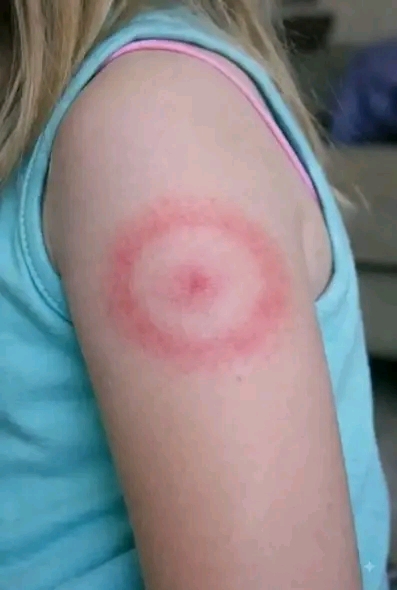
🌸 My Daughter Woke Up With a Strange Red Ring on Her Arm — Should I Be Worried?
Introduction
Seeing a strange red ring suddenly appear on your child’s skin can be frightening, especially when it seems to be getting larger. The good news is that many childhood rashes are minor and treatable. However, a new rash that is clearly spreading should not simply be ignored.
A circular or ring-shaped rash can come from different causes. One possibility is ringworm, a common fungal infection that often produces a red, circular, sometimes scaly or itchy rash.
Another possibility, depending on where your child lives or has recently traveled and whether she may have been bitten by a tick, is erythema migrans, the characteristic expanding rash associated with early Lyme disease. Importantly, this rash can expand without necessarily being itchy.
So instead of panicking, the goal is to carefully observe the rash and know when professional medical assessment is needed.
🧴 The “Ingredients” for a Safe First Check
You don’t need a complicated home remedy. Gather:
- 📏 A ruler or measuring tape
- 📱 Your phone camera
- 🧼 Mild soap and water
- 🩹 A clean dressing if the area needs protection
- 📝 A notebook or your phone for recording changes
- 🌡️ A thermometer
Do not put vinegar, bleach, essential oils, or other irritating substances on the rash.
Also avoid using a steroid cream on a rash that could be ringworm unless a healthcare professional specifically recommends it. Steroids can make ringworm worse.
👀 Method 1: Observe the Rash
Look carefully at the shape.
Ask yourself:
Is it scaly?
A red, circular rash with a raised or scaly edge and clearer skin toward the center can be consistent with ringworm. Ringworm is commonly itchy, although symptoms can vary.
Is it steadily expanding?
An expanding circular rash deserves medical attention, particularly if your child may have had tick exposure.
Lyme disease can cause an erythema migrans rash that expands outward and may develop a target or “bull’s-eye” appearance, although it does not always look like a perfect bull’s-eye.
Is it warm, painful, swollen, or producing pus?
These features can suggest inflammation or infection and make prompt medical assessment more important.
📏 Method 2: Measure It
Take a photograph of the rash today.
Then gently measure its widest point and record the measurement.
For example:
Today: 4 cm
Later: 5 cm
Tomorrow: 7 cm
This information can be extremely useful to a healthcare professional because it shows whether the rash is actually expanding.
Do not repeatedly press, scratch, or rub the area.
🩺 Method 3: Think About Recent Exposure
Before the rash appeared, ask:
- Was she playing outside?
- Could she have been bitten by an insect?
- Has she been around ticks?
- Has she been around pets?
- Does anyone else in the household have a similar rash?
- Has she shared towels, clothing, or bedding with someone who has a fungal rash?
- Has she recently traveled to an area where Lyme disease occurs?
Ringworm can spread through infected people, animals, towels, bedding, and contaminated surfaces.
If there was possible tick exposure and the rash is expanding, tell the healthcare professional specifically about it.
🚨 When Should You Seek Urgent Medical Care?
Seek urgent medical help if your child develops:
- Difficulty breathing
- Swelling of the face, lips, or tongue
- Severe weakness or unusual sleepiness
- Confusion
- Severe pain
- High fever with a rapidly worsening rash
- Rapidly spreading redness with significant warmth or swelling
- Pus or drainage
- A child who looks seriously unwell
Severe symptoms such as breathing difficulty, confusion, inability to stay awake, or significant systemic illness warrant emergency evaluation.
🕐 When Should You Contact Her Doctor?
Because you say the rash looks like it is spreading, I would arrange a medical assessment rather than simply watching it for several days.
This is especially important if:
- The ring continues enlarging.
- It becomes painful.
- It becomes warm or swollen.
- It develops scaling or blisters.
- Your child develops fever.
- There was possible tick exposure.
- The rash does not improve.
- More rings begin appearing.
The CDC recommends medical evaluation for a new unexplained rash, and specifically advises seeking care when a suspected ringworm rash is spreading, painful, or otherwise worsening.
🧼 What Can You Do While Waiting?
Keep the area clean and dry.
Wash your hands after touching the rash.
Don’t allow your child to scratch it.
Don’t share towels, clothing, bedding, or other personal items until you know what caused it, because fungal infections such as ringworm can spread through these items.
If there is a possibility of ringworm, check pets as well. Dogs and cats can carry fungal infections that spread to people.
🌿 A Simple “Home Method”
Think of this as a monitoring method, not a treatment:
Step 1
Take a clear photograph.
Step 2
Measure the diameter.
Step 3
Write down the time and measurement.
Step 4
Check whether your daughter has fever or feels unwell.
Step 5
Look for changes in pain, warmth, swelling, scaling, blisters, or drainage.
Step 6
Contact her pediatrician or another healthcare professional if the rash continues to spread or you are uncertain about its cause.
❤️ Why the History Matters
Skin rashes can look surprisingly similar even when they have completely different causes.
That is why it is risky to diagnose a child’s rash from its shape alone.
For example, ringworm commonly produces a ring-shaped rash, but other conditions can produce circular or expanding redness as well. Healthcare professionals may need to examine the skin and, when appropriate, perform testing to distinguish ringworm from other conditions.
🌸 Formation: How Can a Ring-Shaped Rash Develop?
A ring can form when inflammation or infection affects the skin in a particular pattern.
With ringworm, the fungus grows in the outer layers of the skin and can create a characteristic circular lesion. The rash may gradually enlarge and sometimes develop a clearer center.
With erythema migrans, the redness can expand outward from the original site over time. It can have a target-like appearance, but it does not always have a classic bull’s-eye pattern.
This is why an expanding ring should be assessed rather than automatically assumed to be ringworm.
💕 For Worried Parents
The most important thing is not to panic.
A red ring does not automatically mean something dangerous.
But because your daughter’s rash is new and appears to be spreading, it is reasonable to have it assessed by a healthcare professional, particularly if it continues expanding.
Take a photograph and measurement before the appointment. That simple information can help the clinician understand how quickly it has changed.
🌷 Conclusion
A mysterious red ring on your child’s arm can have several explanations, and the appearance alone cannot reliably tell you which one it is.
If she is otherwise well and has no emergency symptoms, you do not necessarily need to panic or call an ambulance simply because there is a ring-shaped rash.
However, a spreading unexplained rash deserves medical attention.
Watch for fever, pain, warmth, swelling, pus, rapid progression, or any sign that your child is becoming unwell. If any serious symptoms appear, seek urgent medical care.
And remember: don’t experiment with harsh home remedies or steroid creams before the cause is known. A healthcare professional can determine whether the rash is fungal, inflammatory, related to an insect or tick exposure, or something else entirely.
❤️ When it comes to a child’s health, careful observation plus timely professional advice is always better than guessing.