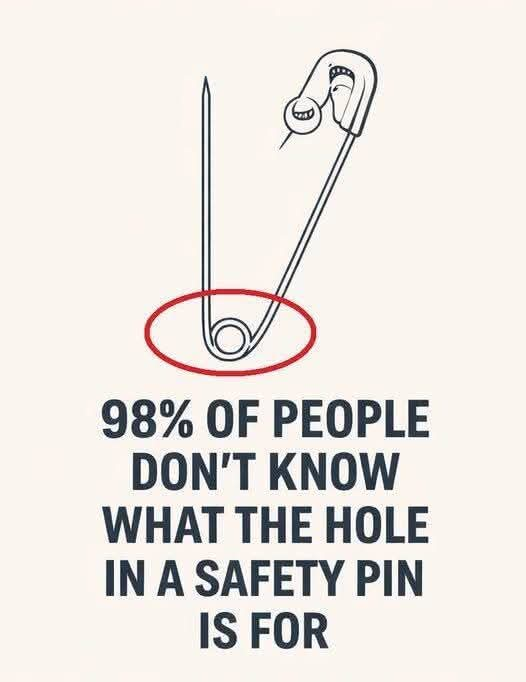
The “Recipe”: The Secret of the Safety Pin
Introduction
For decades, the safety pin has been a humble household object used for everything from holding fabric together to acting as a makeshift zipper pull. Yet, as the viral image suggests, 98% of people overlook a specific design feature: the small, circular hole at the bottom (the coiled end) of the pin. This “recipe” will break down the components, history, and function of this tiny invention to reveal why that hole exists.
Ingredients (The Anatomy of a Safety Pin)
To understand the “recipe,” you must know the components:
· 1 length of rigid wire: Usually brass or steel.
· 1 sharp point: For piercing fabric.
· 1 clasp/cap: The metal cover at the top to shield the point.
· 1 spring coil: The loop at the bottom that provides tension.
· 1 small hole: The mysterious feature highlighted in the image, located inside the coil or just above it.
Instructions (How the Hole Works)
The hole is not a manufacturing defect; it is a functional feature created during the formation of the wire.
- The Manufacturing Process: When the wire is coiled to create the spring mechanism at the bottom, the machine bends the wire tightly. This creates a small gap or loop in the center of the coil.
- The Function: This hole serves as a wire guide. During the manufacturing process, the machinery uses that hole to hold the wire in place while the point and clasp are being stamped and shaped. Without it, the high-speed machines that make millions of pins would not be able to grip the wire properly to bend the top half.
Methods (Alternative Uses)
Beyond manufacturing, savvy users have found methods to utilize the hole:
· Method 1 (Security): You can thread a thin wire or string through the hole and tie it to a zipper or button to prevent the pin from being lost or to create a more permanent repair.
· Method 2 (Jewelry): Crafters use the hole to attach charms or beads to create impromptu jewelry.
· Method 3 (Locking): In some cases, a thin wire can be threaded through the hole and twisted around the clasp to “lock” the pin shut, preventing it from opening accidentally.
History
The safety pin was invented by Walter Hunt in 1849. He invented it in about three hours to pay off a $15 debt. He sold the patent for $400. The design was an improvement on the ancient “fibula” (brooch) used by Greeks and Romans. The specific hole feature has been part of the design since the industrial revolution, allowing for mass production.
Formation (Evolution)
· Ancient Times: The fibula was a single piece of metal, often ornate, but difficult to manufacture quickly.
· 1849: Hunt’s design introduced the coiled spring and the clasp.
· Modern Day: The hole remains a standard feature in the “coiled” end of the pin, though some cheap pins omit it or cover it with plastic. High-quality pins (like those used in military or medical fields) still retain the distinct hole for structural integrity.
Conclusion
The hole in a safety pin is a remnant of the manufacturing process that ensures the spring is coiled tightly and the metal is not weakened. While it is rarely used by the consumer, it is essential for the creation of the pin itself.
Lovers (The Enthusiasts)
Who are the “lovers” of this knowledge?
· Engineers: Who appreciate the efficient design of a 19th-century invention that is still made the same way today.
· DIY Enthusiasts: Who use the hole for crafting and “life hacks.”
· Trivia Buffs: Who enjoy debunking the “98% of people don’t know” myth by explaining the industrial mechanics behind the hole.
Methods (Reprise for Clarity)
To summarize the method of the hole:
- Hold: It holds the wire during manufacturing.
- Reinforce: It acts as a stress relief point for the metal coil.
- Anchor: It allows for string or wire to be anchored to the pin for creative uses.
Verdict: While the graphic claims it’s a mystery, the answer is simple: It’s for the machine that made it.