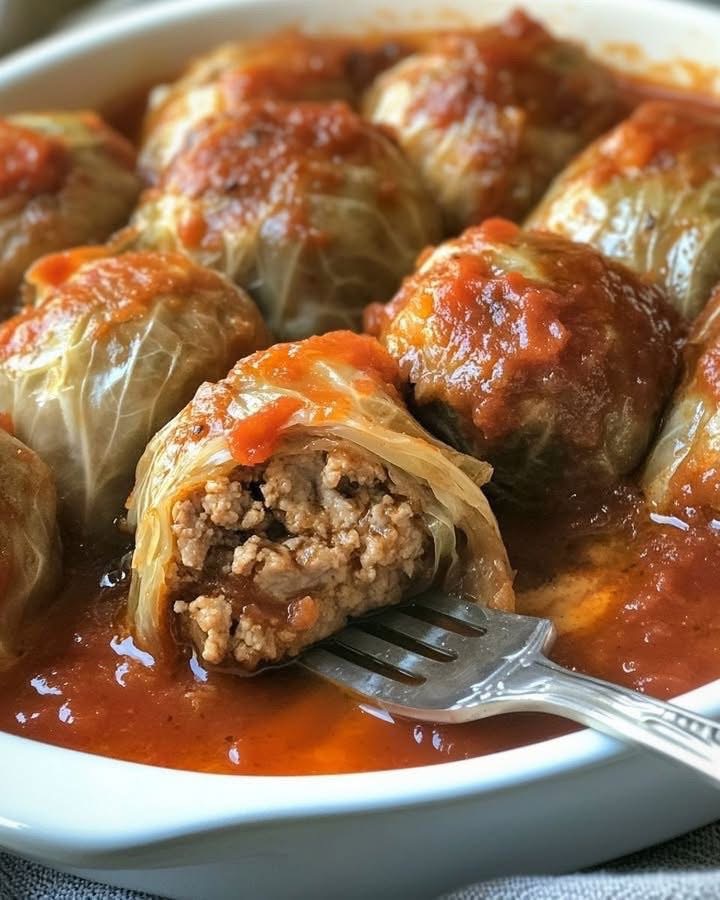
Polish Stuffed Cabbage Rolls, or Gołąbki (pronounced “guh-WUMP-kee”), are a beloved traditional dish in Polish cuisine, often served during family gatherings or holiday celebrations. These comforting rolls are made by wrapping seasoned meat and rice in tender cabbage leaves, then simmering them in a savory tomato sauce. The combination of rich flavors and hearty ingredients makes them a perfect meal for any occasion.
The name “Gołąbki” translates to “little pigeons,” a whimsical name for a dish that is anything but flighty. These rolls are substantial, satisfying, and deeply comforting — the kind of food that fills your kitchen with a wonderful aroma and your belly with warmth. Whether you’re trying this dish for the first time or revisiting a family favorite, these stuffed cabbage rolls are sure to bring warmth to your table.
The beauty of Gołąbki lies in their simplicity. Tender cabbage leaves wrapped around a flavorful filling of seasoned ground meat and rice, all nestled in a sweet-tangy tomato sauce. Every bite delivers a perfect balance of savory meat, soft rice, and that signature tomato brightness.
Serve them with a side of mashed potatoes or crusty bread, and you have a meal that tastes like Eastern European grandmothers have been making for generations.
Why You’ll Love This Recipe
- Authentic Polish comfort food – A traditional recipe passed down through generations.
- Hearty and satisfying – Filling enough to be a complete meal.
- Rich, savory tomato sauce – Sweetened with brown sugar and brightened with lemon.
- Tender cabbage leaves – Soft, pliable, and perfect for wrapping.
- Great for family gatherings – Makes a large batch that feeds a crowd.
- Freezer-friendly – Make a double batch and save one for later.
- Customizable – Use different meats, add mushrooms, or make it vegetarian.
Ingredients
For the Cabbage
- Large head of cabbage – 1
For the Filling
- Ground beef (or a mix of pork and beef) – 1 pound
- Cooked rice – 1 cup
- Small onion – 1, finely chopped
- Egg – 1
- Garlic powder – 1 teaspoon
- Salt – 1 teaspoon
- Black pepper – ½ teaspoon
For the Sauce
- Tomato sauce – 1 can (15 ounces)
- Diced tomatoes – 1 can (14 ounces)
- Brown sugar – 2 tablespoons
- Lemon juice – 1 tablespoon
- Vegetable oil – 1 tablespoon
Ingredient Notes
What kind of cabbage? Green cabbage is traditional. It has sturdy leaves that hold up well to blanching and rolling. Savoy cabbage is more tender and has a milder flavor — it also works beautifully. Avoid red cabbage (it will bleed color into the sauce).
What kind of meat? A mix of ground beef and ground pork is traditional and provides the best flavor (½ pound each). All-beef works well too. Ground turkey or chicken makes a lighter version.
What kind of rice? White rice is traditional. Long-grain or medium-grain both work. Do not use instant rice — it can become mushy. Brown rice works but has a nuttier flavor and chewier texture.
What kind of tomato sauce? Plain canned tomato sauce (not pasta sauce). It should be smooth and unseasoned. Do not use marinara or spaghetti sauce — they have added herbs that will change the flavor.
Why brown sugar and lemon juice?The brown sugar adds sweetness that balances the acidity of the tomatoes. The lemon juice adds brightness and a subtle tang. Together, they create a sauce that’s rich, sweet-tangy, and deeply flavorful.
Step-by-Step Instructions
Step 1: Prepare the Cabbage
Bring a large pot of water to a boil.
While the water heats, remove the corefrom the cabbage. Using a sharp knife, cut a cone-shaped circle around the core and pull it out. This makes it easier to peel off the leaves.
Carefully peel off the leaves from the cabbage, trying to keep them intact. You’ll need about 12–15 leaves, depending on size.
Blanch the cabbage leaves in the boiling water for 2–3 minutes, until softened and pliable. You may need to do this in batches.
Drain the leaves and set aside to cool. Once cool enough to handle, trim the thick center rib from each leaf (cut a shallow V-shape to remove the tough part) so the leaf rolls easily.
Step 2: Make the Filling
In a large bowl, combine:
- 1 pound ground beef (or beef-pork mix)
- 1 cup cooked rice
- 1 small onion, finely chopped
- 1 egg
- 1 teaspoon garlic powder
- 1 teaspoon salt
- ½ teaspoon black pepper
Mix well with your hands or a spoon until everything is evenly combined. Do not overmix — overworking the meat can make the filling dense.
Step 3: Stuff the Cabbage Leaves
Place a cabbage leaf flat on a work surface, with the stem end closest to you.
Add a heaping spoonful of filling(about 2–3 tablespoons, depending on leaf size) to the center of the leaf.
Fold the sides of the leaf inward over the filling. Then, starting from the stem end, roll the leaf up tightly toward the top edge. The filling should be completely enclosed.
Repeat with the remaining cabbage leaves and filling. You should get 12–15 rolls.
Step 4: Make the Sauce
In a separate bowl, mix together:
- 1 can (15 oz) tomato sauce
- 1 can (14 oz) diced tomatoes (with juices)
- 2 tablespoons brown sugar
- 1 tablespoon lemon juice
- A pinch of salt and pepper
Stir until the brown sugar is dissolved.
Step 5: Cook the Rolls
In a large pot or Dutch oven, heat 1 tablespoon of vegetable oil over medium heat.
Place the cabbage rolls in the pot, seam side down to help them stay closed. Arrange them in a single layer or slightly overlapping — they can be snug.
Pour the tomato sauce mixture evenly over the cabbage rolls.
Cover the pot and reduce the heat to low. Simmer for 1 to 1½ hours, occasionally basting the rolls with the sauce (spooning sauce over the tops). The rolls are ready when the cabbage is very tender and the filling is cooked through.
Step 6: Serve
Once the cabbage rolls are tender, remove from heat.
Serve hot, with plenty of sauce spooned over the top. Traditional sides include mashed potatoes, crusty bread, or buttered noodles.
Variations & Tips
Make Them with Pork and Beef (Traditional)
Use ½ pound ground beef and ½ pound ground pork. The pork adds extra moisture and richness. This is the most authentic combination.
Make Them with Mushrooms (Vegetarian)
For a vegetarian version:
- Omit the meat
- Add 1 cup finely chopped mushrooms (sautéed first)
- Add 1 cup cooked lentils or additional rice
- Use vegetable broth instead of meat-based seasonings
Add Bacon
Cook 4 strips of bacon until crispy, crumble, and add to the filling. The smoky, salty bacon adds incredible depth.
Add Dill
Fresh dill is a classic Polish herb. Add 2 tablespoons of chopped fresh dillto the filling, and sprinkle more over the finished dish before serving.
Make the Sauce Creamy
Stir in ½ cup of sour cream into the sauce during the last 10 minutes of cooking. This creates a creamy tomato sauce that’s absolutely divine.
Make Them in the Slow Cooker
- Prepare the cabbage rolls as directed.
- Place them in a slow cooker, seam side down.
- Pour the sauce over the top.
- Cook on LOW for 6–7 hours or HIGH for 3–4 hours.
- No basting needed — the slow cooker does the work.
Make Them in the Instant Pot
- Prepare the cabbage rolls as directed.
- Place them in the Instant Pot, seam side down.
- Pour the sauce over the top.
- Pressure cook on HIGH for 20 minutes.
- Natural release for 10 minutes, then quick release.
Storage & Reheating
Refrigerator: Store leftovers in an airtight container for up to 5 days. The flavors deepen and improve overnight.
Reheating:
- Microwave: 1–2 minutes per serving.
- Stovetop: Warm over medium-low heat, covered, adding a splash of water or broth if the sauce is too thick.
- Oven: 350°F for 15–20 minutes, covered with foil.
Freezing: Gołąbki freeze beautifully for up to 3 months. Freeze the rolls in their sauce in a freezer-safe container. Thaw overnight in the refrigerator before reheating. The texture of the cabbage may soften slightly but the flavor remains excellent.
Frequently Asked Questions (FAQs)
Why are they called “little pigeons”?
The Polish name “Gołąbki” does indeed translate to “little pigeons.” The name likely comes from the shape of the rolls, which resemble plump little birds. It’s a whimsical name for a hearty, down-to-earth dish.
Can I use a different grain instead of rice?
Yes. Cooked barley, quinoa, or even bulgur wheat all work. The texture will be different, but still delicious. Do not use raw rice — it needs to be pre-cooked.
My cabbage leaves keep tearing. What am I doing wrong?
A few possibilities:
- You didn’t blanch the leaves long enough (2–3 minutes is usually enough)
- You’re trying to use leaves that are too small (use the larger outer leaves)
- You’re overstuffing the leaves (use less filling)
- You’re rolling too tightly (gentle but firm is the way)
Can I use sauerkraut instead of cabbage?
Not for this recipe. Sauerkraut is fermented and has a completely different texture and flavor. However, some Polish recipes do layer sauerkraut between cabbage rolls or serve them with sauerkraut on the side.
Can I make these without eggs?
Yes. Omit the egg and add 2 tablespoons of breadcrumbs or mashed potatoes to help bind the filling.
What’s the best way to remove the cabbage core?
Use a sharp paring knife to cut a cone-shaped circle around the core, about 1½ inches deep. Pull the core out with your fingers. This loosens the leaves and makes them easier to peel.
Can I use a different sauce?
Traditional Gołąbki are often served with mushroom gravy or a sour cream-based sauce instead of tomato. For a mushroom gravy, sauté 1 cup of sliced mushrooms in butter, add 2 cups of beef broth, and thicken with a flour slurry.
What to Serve With It
Traditional Polish sides:
- Mashed potatoes – The classic pairing. Spoon extra sauce over the potatoes.
- Crusty bread – For sopping up every drop of tomato sauce.
- Buttered noodles – Wide egg noodles tossed with butter and parsley.
- Steamed or roasted vegetables – Green beans, carrots, or peas.
For a complete Polish feast:
- Polish sausage (Kielbasa) – Sautéed or grilled
- Pickles – Dill pickles or pickled beets
- Cabbage salad (Surowka) – Shredded cabbage with carrot and a tangy vinaigrette
For a lighter meal:
- Simple green salad – With lemon vinaigrette
- Roasted asparagus or Brussels sprouts
The History of Gołąbki
Stuffed cabbage rolls are found in many Eastern European cuisines — Polish, Ukrainian, Czech, Slovak, Hungarian, and Lithuanian, to name a few. Each country has its own variation, but the Polish version (Gołąbki) is perhaps the most famous outside the region.
The dish likely originated as a way to stretch expensive meat with cheap, filling rice. Cabbage was abundant and could be stored for months, making it a winter staple. The tomato sauce became popular in the 19th century as tomatoes became more widely available in Europe.
Today, Gołąbki are a symbol of Polish hospitality and home cooking. They’re served at weddings, Christmas Eve dinner (Wigilia), Easter, and Sunday family dinners. Many Polish families have their own secret recipe passed down from grandmother to granddaughter.
Final Thoughts
These Polish Stuffed Cabbage Rolls (Gołąbki) are the kind of dish that makes a house feel like a home. The tender cabbage, the savory meat-and-rice filling, the sweet-tangy tomato sauce — every bite is warm, comforting, and deeply satisfying.
Making them is a labor of love, but it’s worth it. The aroma that fills your kitchen as they simmer is pure nostalgia. And when you sit down to eat, you’ll understand why this dish has been cherished for generations.
Make them for a special family dinner. Make them for the holidays. Or make them on a cold winter day when you need something warm and hearty. However you serve them, they’ll be loved.