The Great Outlet Orientation Recipe
Introduction
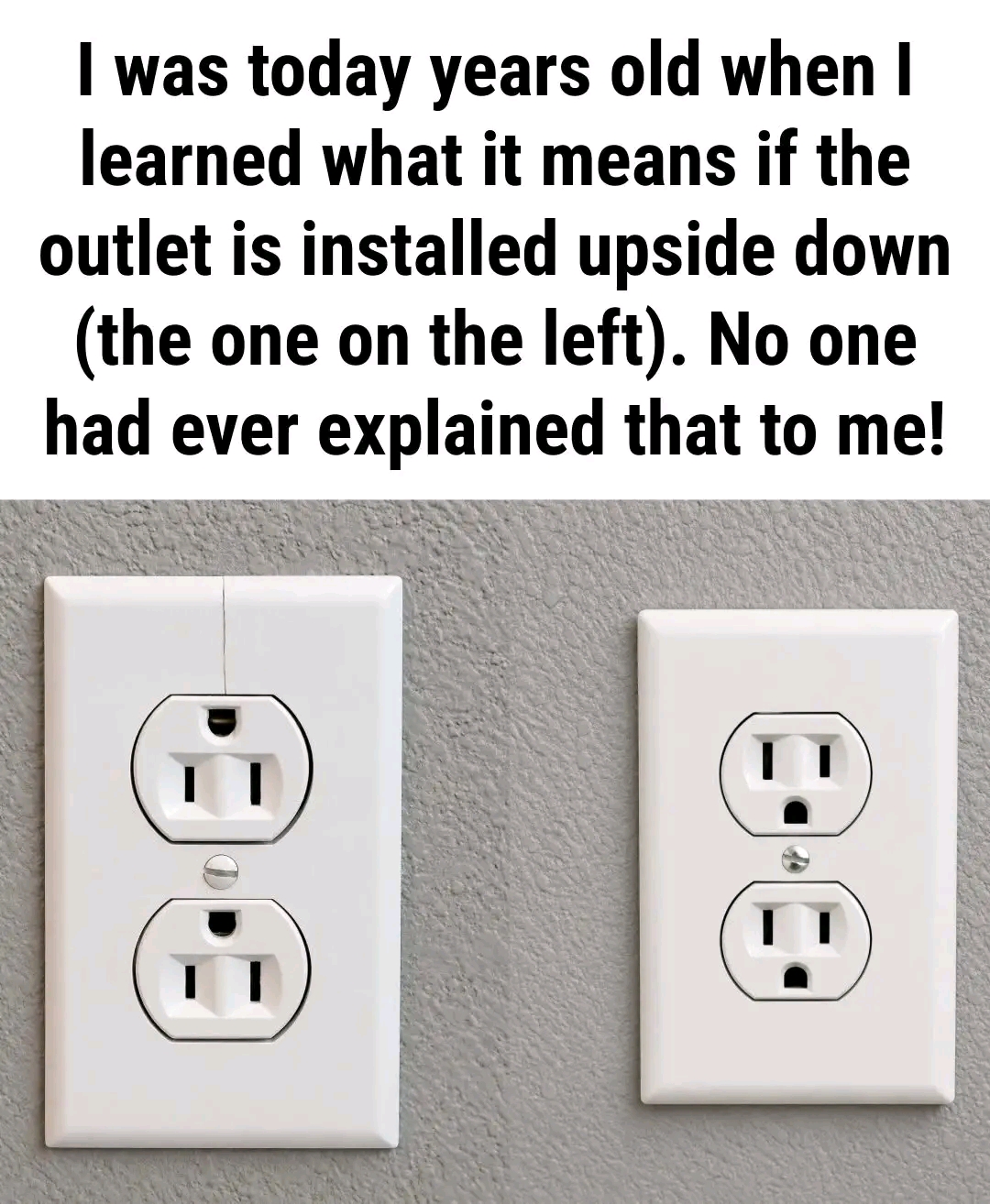
At first glance, the image shows two standard North American 15-amp electrical outlets. The one on the right is installed in the traditional manner (ground pin hole at the bottom). The one on the left is installed with the ground pin hole at the top. The caption says, “I was today years old when I learned what it means if the outlet is installed upside down.”
The truth is, it doesn’t “mean” anything functionally. The electricity flows exactly the same way regardless of orientation. However, the orientation is a subject of intense debate regarding safety, code compliance, and aesthetics. There is no universal law mandating one way over the other in most residential settings, but there are strong arguments for both sides.
Ingredients (The Components)
To understand this recipe, you need the basic parts of a standard NEMA 5-15 receptacle:
· 1x Hot Slot (Black wire): The shorter, straight vertical slot on the right.
· 1x Neutral Slot (White wire): The taller, straight vertical slot on the left.
· 1x Ground Pin Hole (Bare/Green wire): The round hole at the top or bottom.
· 1x Faceplate: The plastic cover.
· 1x Metal Mounting Strap: The metal frame that attaches to the wall box.
A Brief History (The Formation)
In the early days of electricity, plugs were ungrounded (two prongs only). When grounding was introduced in the mid-20th century, the round ground pin was added.
For decades, the standard convention in the United States was to install the outlet with the ground pin down. This was largely an aesthetic choice—it made the outlet look like a “face” (two eyes and a mouth), and it matched the orientation of most appliance cords, which naturally hang down.
However, as building codes evolved, electricians began to notice a safety hazard. If a metal object (like a falling knife or a child’s toy) slid down the wall, it could land perfectly on the two flat hot and neutral prongs, causing a short circuit and a spark. Thus, the “ground-up” movement was born.
Methods (The Great Debate)
There are two primary methods of installation, and both are technically “correct” depending on who you ask.
Method 1: Ground Down (The Traditionalist Method)
· The Look: The ground pin hole is at the bottom.
· The Argument: This is the most common installation in North American homes. It is aesthetically pleasing and matches the natural hang of most power cords.
· The Code: The National Electrical Code (NEC) in the US does not mandate which way is up. It only requires that the outlet be installed according to the manufacturer’s instructions and that the grounding conductor be properly connected.
Method 2: Ground Up (The Safety Method)
· The Look: The ground pin hole is at the top (like the left outlet in your image).
· The Argument: This is often called the “safety orientation.” If a metal object (like a picture frame, a butter knife, or a coin) falls between the plug and the wall, it will hit the ground pin first. This trips the breaker instead of shorting out the hot and neutral wires, potentially preventing a fire or electrocution.
· The Code: The NEC also allows this. In fact, many commercial buildings and hospitals use the ground-up orientation to meet stricter safety standards.
“Formation” (What the Caption is Hiding)
The caption says, “I was today years old when I learned what it means if the outlet is installed upside down.”
The implied joke is that the “upside-down” outlet (left) is a secret signal for something. In reality, there is no hidden meaning. It does not mean the outlet is broken, it doesn’t mean it’s wired backwards, and it doesn’t mean it’s a “European” outlet.
It simply means the electrician who installed it preferred the ground-up orientation, likely for safety reasons or because it was required by a local commercial building code.
Conclusion
If you see an outlet installed “upside down” (ground up), it is not a mistake. It is a deliberate choice.
· If you are a homeowner, you probably have it ground-down because that’s what looks normal.
· If you are in a commercial building or hospital, you likely have it ground-up for safety.
· If you are an electrician, you likely have a strong opinion on which one is superior.
The “Lovers” (The Fanatical Camps)
This topic creates fierce arguments among two groups of “lovers”:
- The “Ground-Up” Safety Lovers: These are usually electricians, engineers, and safety inspectors. They will argue that ground-up is the only logical choice because it prevents short circuits. They often cite the “falling knife” scenario and point out that the NEC allows it, so it’s perfectly legal. They think ground-down is a lazy, outdated aesthetic choice.
- The “Ground-Down” Aesthetic Lovers: These are usually interior designers, homeowners, and traditionalists. They argue that ground-up looks like the outlet is “frowning” or “surprised.” They point out that most appliances are designed with cords that hang down, so a ground-up outlet forces the cord to twist awkwardly. They think ground-up looks “institutional” and ugly.
The Final Verdict:
As long as the wiring behind the wall is correct (Hot to brass, Neutral to silver, Ground to green), both outlets in your image are perfectly safe and functional. The “meaning” is simply a matter of preference and safety philosophy.