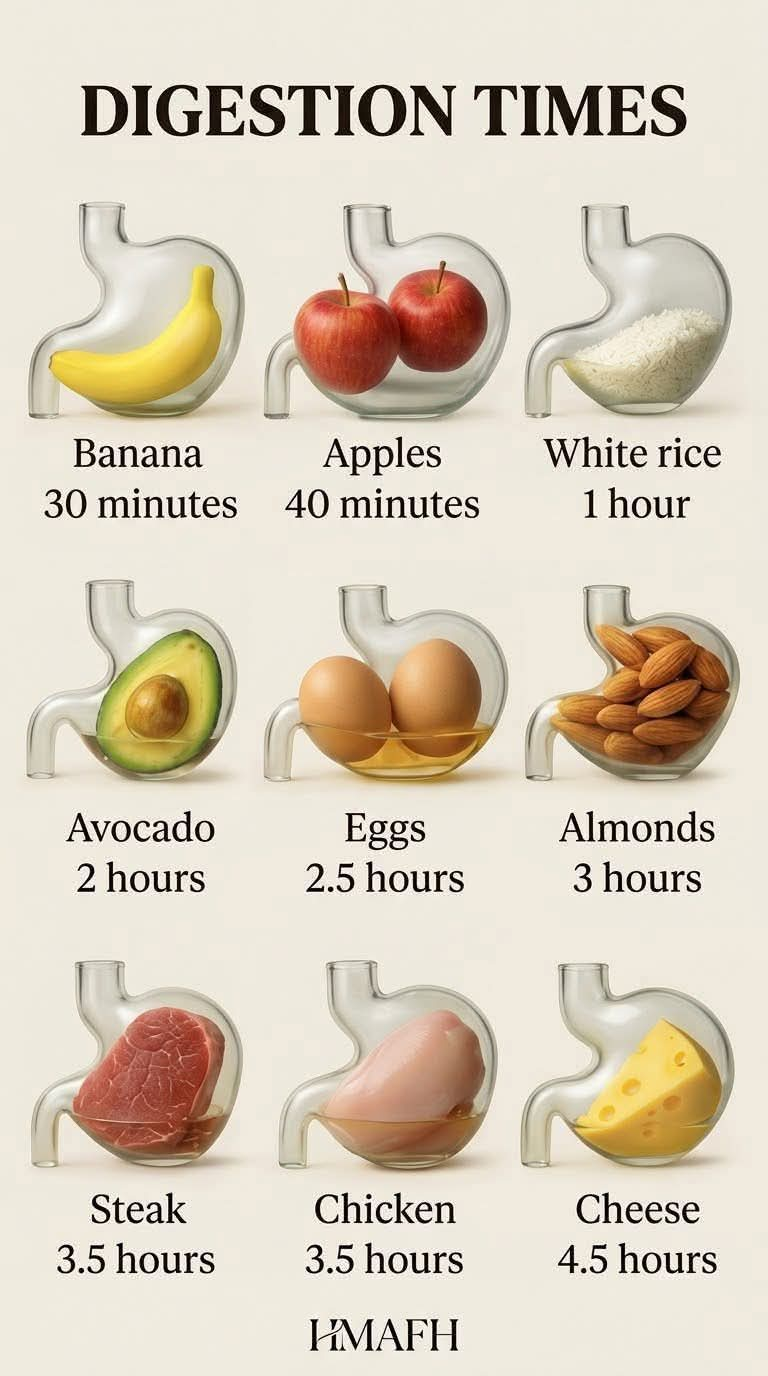
How Long Does Your Food Take to Digest
Introduction
Have you ever wondered what happens to your food after you take that first bite? Digestion is a fascinating process in which your body breaks food down into smaller components so nutrients can be absorbed and used for energy, growth, and repair.
Although you may see charts claiming that certain foods are completely digested in exactly 30 minutes or several hours, digestion doesn’t work according to a simple stopwatch. A food’s journey depends on what you ate, how much you ate, whether it was combined with other foods, and your individual digestive system.
So instead of thinking of foods as having one exact “digestion time,” it’s more useful to understand how different foods can affect the speed of stomach emptying and the overall digestive process.
Ingredients for a Healthy Digestion Plate
For a simple, digestion-friendly meal, try combining:
- 1 ripe banana
- 1 cup plain Greek yogurt
- ½ cup berries
- ¼ cup oats
- 1 tablespoon chia seeds
- A small handful of almonds or walnuts
- 1 glass of water
- A sprinkle of cinnamon, optional
These ingredients provide a mixture of carbohydrates, protein, fiber, healthy fats, and fluids.
Instructions
Step 1 — Prepare the fruit
Slice the banana and wash the berries thoroughly.
Step 2 — Build the bowl
Add the Greek yogurt to a bowl and top with banana slices and berries.
Step 3 — Add fiber
Sprinkle the oats and chia seeds over the fruit.
Step 4 — Add healthy fats
Top with a small portion of almonds or walnuts.
Step 5 — Finish
Add cinnamon if desired and enjoy with a glass of water.
Method
The goal isn’t to create a meal that is supposedly “digested in 30 minutes.” Instead, the method combines several types of food in reasonable portions.
Carbohydrates provide energy.
Protein helps support muscles and body tissues.
Fiber supports normal bowel function and contributes to fullness.
Healthy fats provide energy and help make meals satisfying.
Fluids help support normal digestion and hydration.
What Happens After You Eat?
Digestion begins in your mouth, where chewing breaks food into smaller pieces and saliva begins the digestive process.
The food then travels through the esophagus into the stomach. The stomach mixes the food with digestive juices and gradually releases the stomach contents into the small intestine.
The small intestine is where much of the digestion and nutrient absorption takes place.
The remaining material moves into the large intestine, where water and electrolytes are absorbed and the contents gradually become stool.
So when someone says, “This food takes 30 minutes to digest,” that can be misleading. A food doesn’t simply disappear after a specific number of minutes.
What About Bananas?
Bananas contain carbohydrates, water, and fiber, as well as nutrients such as potassium.
A banana may leave the stomach relatively efficiently compared with a meal that is very high in fat, but its complete journey through the digestive tract takes much longer than 30 minutes.
The ripeness of a banana can also affect its carbohydrate composition and texture.
What About Cheese?
Cheese generally contains substantial amounts of fat and protein. Meals containing more fat tend to empty from the stomach more slowly than low-fat meals.
But saying that cheese always “takes 4.5 hours to digest” is too precise. Different cheeses, portions, meals, and people can produce different digestive patterns.
What About Rice and Other Grains?
Rice and other grains provide carbohydrates. Their digestion can vary according to the type of grain and how it is prepared.
For example, whole grains generally contain more fiber than refined grains, which can affect digestion and fullness.
What About Eggs?
Eggs provide protein and fat. They can be part of a balanced meal, and their digestion is influenced by the amount eaten and what accompanies them.
A boiled egg, for example, is very different from a large meal containing eggs, cheese, butter, and fried foods.
 What About Meat?
Meat is rich in protein and, depending on the cut, may contain considerable fat.
A lean piece of meat in a small meal can behave differently from a large, fatty serving accompanied by fried foods.
This is another reason why assigning one exact digestion time to an individual food can be misleading.
 What About Vegetables?
Vegetables contain varying amounts of fiber, water, and carbohydrates.
Leafy greens, broccoli, carrots, squash, and other vegetables all have different nutritional compositions.
Fiber isn’t simply “digested” like sugar or protein. Some types of fiber pass through the digestive system largely intact and can be fermented by gut bacteria in the colon.
What About Fatty Foods?
Fat tends to slow stomach emptying.
That doesn’t mean fatty foods are automatically unhealthy, but meals that are very high in fat can remain in the stomach longer and may feel heavier.
Portion size matters too.
 The Role of Water
Water doesn’t have a single digestion time either.
Some water can be absorbed relatively quickly, while the overall movement of fluids through the digestive tract depends on what else is in the stomach and intestines.
Staying adequately hydrated supports normal bodily functions, including digestion.
History of Understanding Digestion
Humans have wondered about digestion for thousands of years.
Ancient physicians developed theories about how food was transformed inside the body. Over centuries, scientists gradually discovered the roles of the stomach, digestive juices, pancreas, liver, and intestines.
Modern digestive science shows that digestion is a coordinated process involving mechanical movement, enzymes, acids, bile, hormones, nerves, and trillions of microorganisms living in the gastrointestinal tract.
What once seemed like a mysterious process can now be studied in remarkable detail.
Formation of the Digestive Process
The digestive process can be thought of in several stages:
1. Ingestion
Food enters the mouth.
2. Mechanical digestion
Chewing breaks food into smaller pieces.
3. Chemical digestion
Enzymes and digestive fluids break nutrients into smaller molecules.
4. Stomach processing
Food is mixed and gradually released into the small intestine.
5. Nutrient absorption
The small intestine absorbs many nutrients.
6. Large-intestine processing
Water is absorbed and intestinal bacteria interact with remaining material.
7. Elimination
Waste eventually leaves the body.
Foods Lovers’ Guide
For people who love fruit:
 Bananas
 Strawberries
 Blueberries
 Apples
 Oranges
For protein lovers:
 Eggs
 Fish
 Chicken
 Greek yogurt
 Beans and lentils
For vegetable lovers:
Broccoli Carrots
 Spinach
 Cucumbers
 Tomatoes
For whole-grain lovers:
 Oats
 Brown rice
 Whole-grain bread Barley
A Simple Digestion-Friendly Meal
Try this balanced plate:
Protein: grilled chicken or fish
Carbohydrate: brown rice or potatoes
Vegetables: steamed broccoli and carrots
Healthy fat: a small amount of olive oil or avocado
Fruit: berries or a banana
Drink: water
This provides a variety of nutrients rather than focusing on the supposed digestion time of one individual food.
Healthy Digestion Methods
Eat slowly
Chew your food thoroughly rather than rushing through meals.
Include fiber
Fruits, vegetables, legumes, nuts, seeds, and whole grains can contribute fiber to the diet.
Drink enough fluids
Adequate hydration supports normal digestive function.
Keep portions reasonable
Very large meals can feel uncomfortable and may take longer to leave the stomach.
Stay active
Regular physical activity supports overall health and normal bowel function.
Pay attention to your body
Different people tolerate different foods differently. Notice which foods make you feel comfortable or uncomfortable.
A Note About Viral Digestion Charts
You may see social-media graphics claiming:
“Fruit — 30 minutes.”
“Vegetables — 1 hour.”
“Meat — 4 hours.”
“Cheese — 4.5 hours.”
These numbers should not be treated as exact scientific measurements for every person.
Digestion is a continuous process, and mixed meals contain multiple nutrients that are processed simultaneously. The stomach doesn’t simply digest each food separately according to a fixed timer.
Conclusion
Digestion is much more fascinating than a simple list of foods and exact hours.
Your body continuously breaks down food, absorbs nutrients, moves material through the gastrointestinal tract, and works with beneficial microorganisms along the way.
Instead of asking, “How many minutes does this food take to digest?” a more useful question is:
“What nutrients does this food provide, how does it fit into my overall diet, and how does my body respond to it?”
A balanced diet containing vegetables, fruits, whole grains, protein foods, healthy fats, and adequate fluids can support overall digestive health.
For Food Lovers
If you love learning what happens to food after you eat it, digestion is one of the most interesting journeys in the human body.
Every meal begins a complex process involving the mouth, stomach, intestines, digestive enzymes, hormones, and gut bacteria.
So enjoy your food, chew slowly, choose a variety of nutritious foods, and remember: your digestive system doesn’t follow a simple stopwatch.