🏠 “Mystery Pile” Home Pest-Cleanup Recipe
Introduction
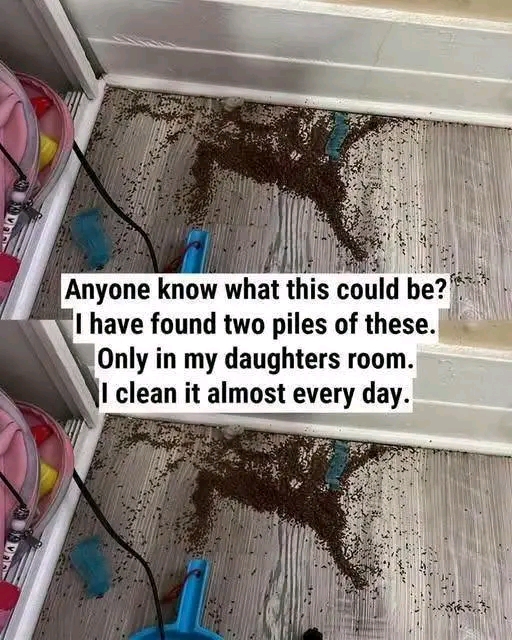
Finding two piles like this in your daughter’s room can certainly be alarming, especially when you clean the room regularly. The important thing is not to assume that poor cleanliness caused it. Some household pests hide inside wall cavities, wooden trim, furniture, flooring, or undisturbed fabrics and can produce debris even in a very clean room.
The position in your photograph—right beside the baseboard/woodwork—is an important clue. Insect debris that repeatedly appears underneath a particular crack, hole, or piece of wood deserves closer inspection.
Ingredients
For the investigation and cleanup, gather:
- 1 flashlight
- 1 magnifying glass or phone camera with zoom
- 1 ruler or coin for scale
- Disposable gloves
- Paper towels
- A small sealable plastic bag or container
- Vacuum cleaner
- Mild household cleaner
- A stiff brush
- A notebook or phone for photographs
- Sticky insect-monitoring traps, if appropriate
- Patience—don’t immediately spray everything with insecticide
Method 1 — Preserve the Evidence
Before cleaning the next pile:
- Photograph the entire area.
- Take a close-up photograph.
- Put a coin or ruler beside the material and photograph it again.
- Look directly above the pile.
- Check the baseboard, door frame, flooring and nearby furniture for tiny holes, cracks or openings.
- Look for fresh material coming from one particular point.
This is useful because the shape, size, uniformity and exact location of the particles can help distinguish different pests.
Method 2 — Inspect the Bedroom
Move the bed and furniture away from the wall and carefully inspect:
- Baseboards
- Door frames
- Wooden furniture
- Behind wardrobes
- Under the bed
- Carpet edges
- Closet corners
- Wool or natural-fiber clothing
- Stored blankets
- Cardboard boxes
- Any wooden trim
If you find small holes in wood with fresh material beneath them, that raises suspicion of a wood-boring insect. Carpenter ants, for example, can produce coarse sawdust-like debris when excavating wood.
Method 3 — Don’t Forget Carpet Beetles
Another possibility worth checking is carpet beetles, particularly if the room contains carpets, wool, feathers, fur, silk, stuffed animals or other natural materials.
Carpet beetle larvae are small, hairy/bristly larvae, and infestations can produce powdery debris and shed larval skins. They commonly hide in quiet areas such as carpet edges, closets and underneath furniture.
Look for:
- Tiny hairy brown larvae
- Shed skins
- Small holes in wool or natural fabrics
- Damage underneath furniture
- Small beetles around windows
Method 4 — Clean After Documenting
Once you’ve photographed everything, vacuum the pile thoroughly.
Then:
- Vacuum along the entire baseboard.
- Vacuum under furniture.
- Empty the vacuum outside if possible.
- Wipe the floor and baseboard with an appropriate household cleaner.
- Wash bedding and clothing normally if they were directly beside the debris.
- Leave the area clean and dry.
Do not spray insecticide randomly, because identifying the source first is much more useful than treating an unknown pest.
Method 5 — The Most Important Test
After cleaning, mark the exact location and take another photograph.
Then check it again after 24–48 hours.
If the same material appears again—especially if it is coming from exactly the same crack, hole, baseboard or piece of wood—that is much more significant than a one-time pile.
Repeated fresh piles can indicate an active source.
History & Formation
The material in the photograph could be what pest professionals call frass, a general term for debris associated with insect feeding or excavation. Different insects produce very different-looking frass.
Carpenter ants can leave coarse wood particles mixed with other material when they excavate galleries. Some wood-boring insects produce very fine powder, while drywood termites can produce relatively uniform granular pellets.
Carpet beetles are different: their larvae feed on materials such as wool, silk, fur, feathers and leather, and their activity can leave powdery droppings and shed skins.
My best interpretation of your photograph
I would investigate the baseboard/woodwork first.
The enormous number of tiny particles and their concentration along the edge of the room make me more interested in an insect/frass source than ordinary dirt. However, I would not confidently call it termites, carpenter ants, carpet beetles, or anything else from this photograph alone.
Conclusion ❤️
Don’t blame yourself because you clean the room every day. A clean bedroom can still have insects hiding inside wood, cracks, furniture or fabrics.
The best next step is to clean the area, monitor the exact spot, and inspect the wood immediately above the pile. If fresh material returns, particularly from a tiny hole in the wood, consider having a pest professional identify the debris and inspect the structure.
And if you can take one very close photograph of the individual particles with a coin beside them, I can help you narrow down whether they look more like termite pellets, carpenter-ant frass, carpet-beetle debris, rodent droppings, or something else.