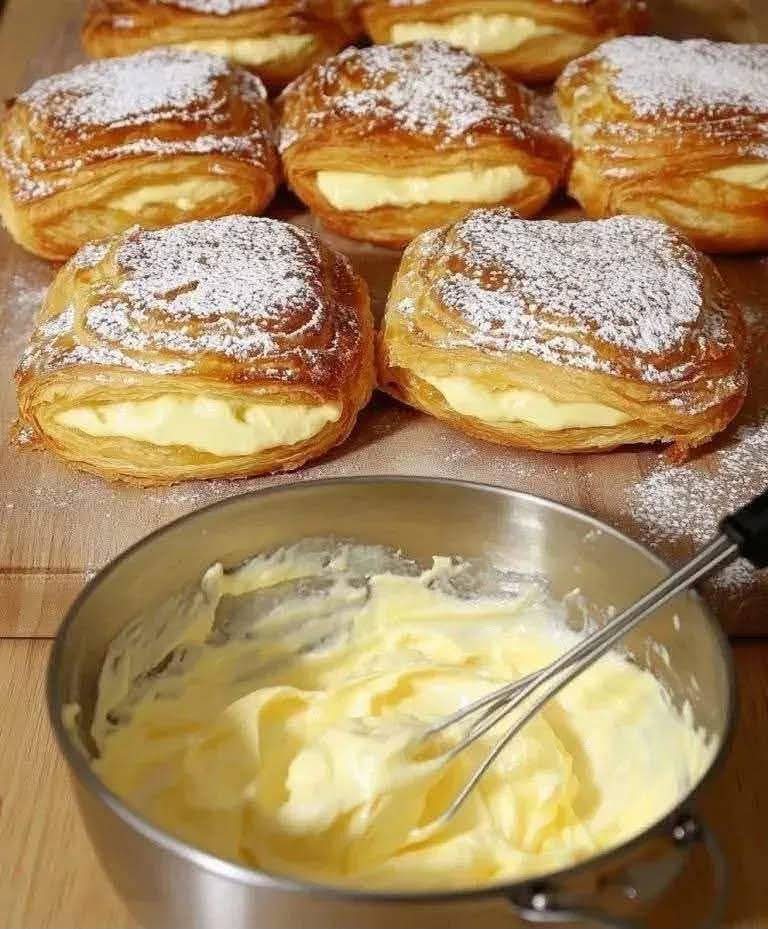
🇫🇷 French Vanilla Custard Tart — Flan Pâtissier
✨ Introduction
There are desserts that are complicated and impressive, and then there are desserts that prove simple ingredients can create something extraordinary.
This French Vanilla Custard Tart is one of those timeless recipes. Imagine a beautifully golden, crisp pastry shell filled with a thick, tender vanilla custard that is smooth, creamy, fragrant, and delicate in the center. Each slice gives you the contrast of crunchy pastry and soft vanilla cream in one bite.
Known as flan pâtissier or flan parisien, this style of custard tart is a familiar French bakery classic. Traditional versions use pastry and a generously thick vanilla custard, baked until the surface becomes beautifully browned.
It is elegant enough for a dinner party but comforting enough for an ordinary afternoon with coffee or tea.
🥧 Ingredients
For the pastry
- 250 g all-purpose flour
- 125 g cold unsalted butter, cubed
- 70 g powdered sugar
- 1 large egg
- 1 teaspoon vanilla extract
- 1/4 teaspoon salt
- 1–2 tablespoons cold water, only if necessary
For the vanilla custard
- 750 ml whole milk
- 250 ml heavy cream
- 150 g granulated sugar
- 4 large eggs
- 3 large egg yolks
- 80 g cornstarch
- 1 vanilla bean, split and scraped
- 2 teaspoons pure vanilla extract
- 30 g unsalted butter
- Pinch of salt
For finishing
- Butter and flour for the tart pan
- Powdered sugar, optional
- Fresh berries, optional
- Fresh mint, optional
👩🍳 Method 1 — Making the Pastry
Step 1: Prepare the dough
Place the flour, powdered sugar, and salt in a large bowl.
Add the cold butter and rub it into the flour with your fingertips until the mixture resembles fine crumbs.
Add the egg and vanilla. Mix gently until the dough begins to come together.
If the dough seems dry, add cold water one teaspoon at a time.
Do not overwork the dough. The less you knead it, the more tender and crisp your pastry will be.
Step 2: Chill
Shape the dough into a flat disc.
Wrap it and refrigerate for at least 30–60 minutes.
This resting time allows the butter to firm up and helps prevent the pastry from shrinking during baking.
Step 3: Roll the pastry
Lightly flour your work surface.
Roll the chilled dough to approximately 3–4 mm thick.
Carefully place it into a 22–24 cm tart pan with reasonably high sides.
Press the dough gently into the corners and sides.
Trim the excess pastry.
Prick the bottom several times with a fork.
Refrigerate the prepared shell for another 20–30 minutes.
🍮 Method 2 — Making the Vanilla Custard
Pour the milk and cream into a saucepan.
Add the vanilla seeds and vanilla pod.
Heat gently until the mixture is steaming and almost boiling.
Do not allow it to aggressively boil.
Meanwhile, whisk the eggs, egg yolks, sugar, cornstarch, and salt in a large bowl.
Whisk until smooth and pale.
Slowly pour the hot milk mixture into the egg mixture while whisking continuously.
This gradual process prevents the eggs from scrambling.
Return everything to the saucepan.
Cook over medium heat, whisking constantly.
After several minutes, the custard will become noticeably thick and glossy.
Remove from the heat.
Take out the vanilla pod.
Add the butter and vanilla extract.
Whisk until completely smooth.
The finished custard should resemble a thick pastry cream.
🔥 Method 3 — Forming the Tart
Preheat your oven to 200°C / 400°F.
Pour the warm vanilla custard into the chilled pastry shell.
Smooth the surface gently with a spatula.
Do not fill the tart completely to the very top if your pan is shallow; leave a little room for the custard to rise during baking.
Place the tart on a baking tray.
🔥 Method 4 — Baking
Bake at 200°C / 400°F for approximately 35–45 minutes, depending on the depth of your tart.
The top should become beautifully golden brown, with some darker caramelized areas.
The center may still have a slight wobble when you remove it from the oven.
That is exactly what you want.
Do not wait for the custard to become completely firm in the oven, because it will continue setting as it cools.
French custard-tart recipes commonly use a hot oven and bake the thick custard until the surface develops a characteristic browned finish.
❄️ Method 5 — Cooling
Place the tart on a cooling rack.
Allow it to cool completely at room temperature.
Then refrigerate it for at least 3–4 hours, preferably overnight.
This step is important.
The custard becomes beautifully smooth and sliceable as it cools.
For the cleanest slices, use a sharp knife dipped briefly in hot water and wiped dry between cuts.
🌸 Formation & Presentation
For a beautiful French bakery-style presentation, place one generous slice in the center of a dessert plate.
Dust the top lightly with powdered sugar if desired.
You can add:
- A few fresh raspberries
- Strawberries
- Blueberries
- A small mint leaf
- A spoonful of lightly whipped cream
- A drizzle of caramel sauce
But don’t overdecorate it.
The beauty of this dessert is its simplicity.
The golden crust and creamy vanilla center should remain the stars of the plate.
📜 A Little History
Custard tarts have a long European history, and their exact origins are difficult to assign to a single country. French sources describe medieval recipes for flaon, while related custard pastries also developed elsewhere in Europe.
The French flan pâtissier, sometimes called flan parisien, eventually became strongly associated with French bakeries. It is essentially a baked custard enclosed in pastry, with vanilla providing much of its characteristic aroma.
Modern French versions vary considerably. Some use flaky pastry, while others use shortcrust or sweet pastry. The filling can also range from relatively soft to very thick and sliceable.
One modern French vanilla custard tart recipe, for example, combines sweet pastry with vanilla custard and emphasizes the contrast between crunchy pastry and creamy filling.
💡 Secrets for the Perfect Tart
1. Keep the butter cold
Cold butter helps produce a delicate, crisp pastry.
2. Don’t overwork the dough
Too much mixing can make the crust tough.
3. Use real vanilla when possible
A vanilla bean gives the custard beautiful black vanilla seeds and a deep aroma.
4. Whisk continuously
When cooking the custard, constant whisking prevents lumps and scorching.
5. Don’t panic about the wobble
A slightly trembling center is desirable when the tart comes out of the oven.
6. Let it cool completely
Cutting the tart while it is hot can cause the custard to collapse or produce messy slices.
7. Chill overnight for the best texture
The following day, the custard will be firm, creamy, and exceptionally easy to slice.
❤️ Who Will Love This Dessert?
This recipe is perfect for:
❤️ Lovers of French pastries
❤️ Vanilla lovers
❤️ Custard lovers
❤️ Fans of creamy desserts
❤️ People who enjoy traditional bakery recipes
❤️ Afternoon tea gatherings
❤️ Family celebrations
❤️ Birthday dessert tables
❤️ Sunday lunches
❤️ Dinner parties
❤️ Anyone who loves the combination of crisp pastry and silky cream
It is especially wonderful with a cup of coffee, espresso, black tea, or a small glass of dessert wine.
☕ Serving Suggestions
Serve the tart chilled or slightly cool.
For a simple French-inspired afternoon:
One slice of vanilla flan + strong coffee + good conversation = perfection.
For a more luxurious dessert, serve it with lightly whipped cream and fresh berries.
For a caramel lover’s version, drizzle a little salted caramel over each slice.
For a citrus variation, add a little finely grated orange or lemon zest to the custard.
🥮 Texture & Flavor
The finished tart should have three beautiful characteristics:
The crust
Golden, crisp, buttery, and slightly sweet.
The filling
Smooth, creamy, rich, and intensely vanilla-scented.
The top
Deep golden and lightly caramelized.
The magic is in the contrast: crisp outside, tender inside.
🍰 Conclusion
This French Vanilla Custard Tart is proof that you don’t need dozens of ingredients to create an unforgettable dessert.
Flour, butter, eggs, milk, sugar, cornstarch, and vanilla come together to create something that tastes far more luxurious than the ingredient list suggests.
When you cut through that golden crust and reveal the creamy vanilla center, you get the classic French bakery experience right in your own kitchen.
So pour yourself a coffee, invite the people you love, slice the tart generously, and enjoy every creamy, buttery bite.
Bon appétit! 🇫🇷🥧❤️