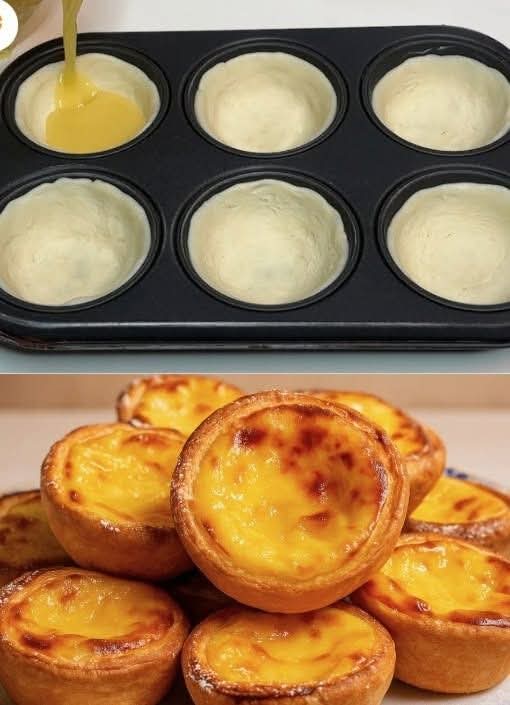
🇵🇹 Pastéis de Nata — Traditional Portuguese Custard Tarts
🌟 Introduction
Few Portuguese desserts are as famous, irresistible, and instantly recognizable as Pastéis de Nata. These little custard tarts combine a beautifully crisp, flaky pastry shell with a rich, silky custard filling and a wonderfully caramelized surface.
The magic happens when the tarts are baked at a very high temperature. The pastry becomes golden and crunchy while the custard develops those characteristic dark, blistered spots on top. Served warm with a dusting of cinnamon and powdered sugar, they are absolutely heavenly with coffee or tea. 😋☕🇵🇹
This homemade recipe gives you everything you want from a classic pastel de nata: crisp layers, creamy custard, fragrant lemon and cinnamon, and a beautifully browned top.
🛒 Ingredients
For the Pastry
- 1 sheet of good-quality all-butter puff pastry, about 250–300 g
- A little softened butter, for preparing the molds if needed
For the Custard
- 500 ml whole milk
- 200 g granulated sugar
- 120 ml water
- 40 g all-purpose flour
- 6 large egg yolks
- 1 cinnamon stick
- 2 strips of lemon zest
- 1 teaspoon vanilla extract
- Pinch of salt
For Serving
- Ground cinnamon
- Powdered sugar, optional
👩🍳 Instructions
1. Prepare the Pastry
Start by taking the puff pastry out of the refrigerator and allowing it to soften slightly while remaining cool.
Roll the pastry tightly into a long cylinder or log. The tighter you roll it, the more defined your layers will be.
Cut the pastry log into approximately 12 equal pieces.
Place one piece into each cavity of a muffin tin, with the cut side facing upward.
Using wet fingertips, gently press the pastry outward from the center, forming a thin pastry cup.
The pastry should cover the bottom and sides of each cavity, with the edges slightly higher than the center.
Place the prepared tin in the refrigerator while you make the custard.
🥛 2. Make the Milk Mixture
Pour the milk into a saucepan.
Add:
- Cinnamon stick
- Lemon zest
- Vanilla
- Pinch of salt
Warm the milk gently over medium heat until it is hot and fragrant, but don’t allow it to boil aggressively.
Remove from the heat and let it infuse for about 10 minutes.
This simple step gives the custard its beautiful Portuguese-style aroma.
🍯 3. Make the Sugar Syrup
Place the sugar and water in a separate saucepan.
Heat over medium heat until the sugar dissolves.
Bring the mixture to a gentle boil and cook for approximately 3–5 minutes.
You don’t need a very thick caramel. You’re looking for a clear sugar syrup.
Remove it from the heat.
🌾 4. Prepare the Flour Mixture
Place the flour in a bowl.
Gradually whisk in a little of the warm infused milk until smooth.
Continue adding the milk gradually, whisking constantly to prevent lumps.
Pour this mixture back into the saucepan.
Cook over medium-low heat, whisking constantly, until the mixture becomes slightly thickened.
Do not allow it to become extremely thick.
🥚 5. Add the Egg Yolks
Allow the milk mixture to cool slightly.
Remove the cinnamon stick and lemon zest.
In another bowl, lightly whisk the egg yolks.
Slowly add some of the warm milk mixture to the yolks while whisking continuously.
This is called tempering the eggs and prevents them from scrambling.
Return the egg mixture to the saucepan.
Stir gently until everything is completely combined.
Finally, slowly incorporate the warm sugar syrup.
Your custard should be smooth, glossy, and pourable.
🥧 6. Fill the Pastry Shells
Take the pastry-lined muffin tin from the refrigerator.
Pour the custard into each pastry shell.
Fill each one to roughly ¾ full, leaving a little space at the top.
Don’t overfill them because the custard will expand slightly during baking.
🔥 7. Bake the Pastéis de Nata
Preheat your oven as high as it safely allows, ideally around 250°C / 480°F.
Place the tarts in the hot oven.
Bake for approximately 10–15 minutes, depending on your oven.
You’re looking for:
- Deep golden pastry
- Set but slightly jiggly custard
- Dark caramelized spots on the surface
- Crisp, flaky edges
Those dark spots on the custard are one of the signature characteristics of Pastéis de Nata.
If your oven doesn’t reach 250°C, bake at the highest temperature it can safely maintain and allow a few extra minutes.
Keep a close eye on them during the final minutes.
❄️ 8. Cool and Serve
Remove the tarts from the oven.
Let them rest in the pan for several minutes.
Carefully remove them and place them on a wire rack.
They are wonderful served slightly warm.
Finish with a light dusting of:
✨ Ground cinnamon
✨ Powdered sugar
Then take that first bite while the pastry is still crisp and the custard is creamy.
🇵🇹 The History of Pastéis de Nata
Pastéis de Nata are one of Portugal’s most beloved culinary symbols.
The tradition of Portuguese custard pastries is closely associated with convent and monastery baking. Historically, egg yolks were used extensively in Portuguese sweets, while egg whites were often needed for other culinary purposes or household tasks.
This helped create a remarkable tradition of yolk-rich desserts.
The famous Pastéis de Belém are particularly associated with Lisbon’s Belém district. The pastry became an important part of Portuguese food culture and eventually spread far beyond Portugal.
Today, Pastéis de Nata can be found throughout Portugal and in Portuguese communities around the world.
Although many bakeries have their own techniques, the essential idea remains wonderfully simple:
flaky pastry + creamy egg custard + intense heat = Portuguese perfection.
🥧 The Formation of the Tart
The structure of a perfect pastel de nata comes from three important components.
1. The Pastry
The puff pastry provides the crunchy foundation.
When properly rolled and baked, its many layers separate and become beautifully flaky.
2. The Custard
The custard should be creamy rather than firm.
Egg yolks provide richness and color, while milk gives the filling its smooth texture.
3. The Caramelized Top
The extremely hot oven is essential.
The surface of the custard becomes intensely browned and develops the characteristic dark spots that make Pastéis de Nata so recognizable.
💡 Secrets for Better Pastéis de Nata
Keep the pastry cold
Cold pastry produces better layers and helps prevent excessive spreading.
Don’t overwork the pastry
Handle it gently so you don’t destroy the delicate layers.
Temper the egg yolks
Always introduce the hot mixture gradually into the yolks.
Don’t overcook the custard
The filling continues setting as it cools.
Use a very hot oven
High heat is one of the secrets behind the characteristic appearance of authentic-style custard tarts.
Don’t worry about dark spots
Those beautiful browned patches are part of the charm!
☕ How to Serve Them
Pastéis de Nata are traditionally wonderful with coffee.
Try serving them with:
- ☕ Espresso
- 🇵🇹 Portuguese coffee
- 🍵 Black tea
- Cinnamon
- Powdered sugar
- Fresh berries on the side
For the best experience, eat them while they’re still slightly warm.
❤️ Who Will Love This Recipe?
This recipe is perfect for:
❤️ Lovers of Portuguese desserts
❤️ Custard lovers
❤️ Puff-pastry fans
❤️ Coffee-and-dessert lovers
❤️ People who enjoy European baking
❤️ Brunch hosts
❤️ Family gatherings
❤️ Afternoon tea
❤️ Anyone who loves crispy and creamy desserts!
🍮 Storage
Pastéis de Nata are best eaten fresh on the day they’re made.
If you have leftovers, store them covered in the refrigerator for up to a couple of days.
To bring back some of their crispness, warm them briefly in a hot oven or air fryer.
Avoid microwaving if possible because it can make the pastry soft.
🌟 Final Conclusion
There is something truly special about a freshly baked Pastel de Nata.
The first thing you notice is the golden, flaky pastry. Then comes the smooth custard, followed by the subtle fragrance of lemon and cinnamon and those delicious caramelized spots on top.
Making them at home takes a little patience, but the result is absolutely worth it.
Serve them warm, sprinkle them with cinnamon, pour yourself a cup of coffee, and enjoy a little taste of Portugal right from your own kitchen. 🇵🇹❤️
One bite is usually all it takes to understand why Pastéis de Nata have lovers around the world! 😋🥧☕